AHK-Cu Research: Structure and Laboratory Studies
AHK-Cu Research: Structure and Laboratory Studies
Research only. All AVM Labs USA products are sold strictly for laboratory research. Nothing on this page is medical advice, and nothing here describes use in humans or animals.
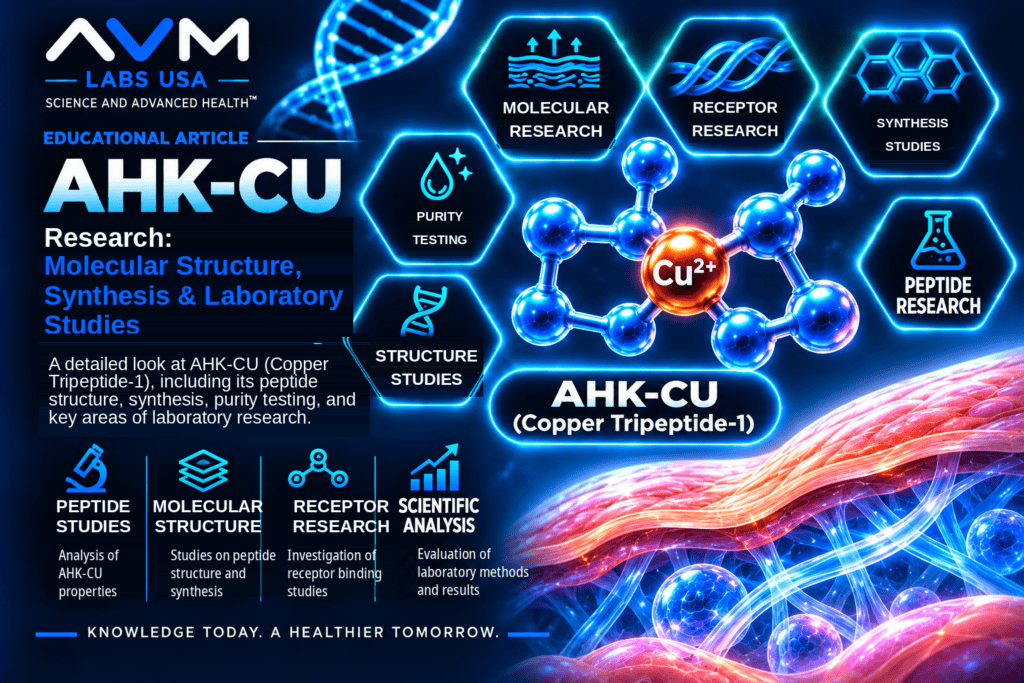
AHK-Cu is one of the shortest copper peptides in the research catalogue: three amino acids and one copper ion. This guide explains it the way the laboratory literature does: its molecular structure, how it is synthesized and characterized, and how to read the studies that mention it.
What AHK-Cu is, in laboratory terms
AHK-Cu is the copper(II) complex of the tripeptide L-alanyl-L-histidyl-L-lysine. It is also catalogued as Copper Tripeptide-3 and as Ala-His-Lys copper. The peptide part is three residues — alanine, histidine and lysine, joined by two peptide bonds — and the copper(II) ion is bound to that chain, through the histidine imidazole and the terminal amine groups.
The copper is part of the identity, not an additive. A lot described as AHK-Cu must be identified by the mass of the complex, not by the mass of the peptide alone.
Molecular structure
The reported molecular identity of AHK-Cu is:
- A three-amino-acid chain — Ala-His-Lys, written AHK in one-letter code, H-Ala-His-Lys-OH as the free peptide. All three residues are the L-form.
- The free peptide — formula C15H26N6O4, molecular weight approximately 354.41 g/mol, CAS 126828-32-8, PubChem CID 7408502. That is the peptide without copper.
- The copper(II) complex — formula C15H24CuN6O4, molecular weight approximately 415.94 g/mol, monoisotopic mass 415.1155 Da, PubChem CID 176418766. In this representation two protons leave the peptide when the copper binds: one from a backbone amide nitrogen and one from the C-terminal carboxyl group.
- Copper content — about 15.3% of the dry 1:1 complex, calculated from the formula above.
At approximately 415.94 Da for the complex, AHK-Cu is a small copper peptide, and that mass is the first identity check on a COA.
These are the structural facts a Certificate of Analysis verifies: the sequence, the three residues, the copper complex, and the molecular weight.
AHK-Cu is not the free peptide, not the chloride salt, and not GHK-Cu
Four records in this family are often confused, and the laboratory tells them apart by formula and mass alone:
- AHK-Cu, the 1:1 complex — C15H24CuN6O4, approximately 415.94 Da. This is the material this post describes.
- AHK, the free peptide — C15H26N6O4, approximately 354.41 Da, CAS 126828-32-8. Same chain, no copper, about 61.5 Da lighter. A COA that reads near 354.4 Da has identified the peptide, not the complex.
- AHK-Cu as a chloride salt — C15H24ClCuN6O4, approximately 451.39 Da. Same complex with a chloride counter-ion, about 35.5 Da heavier. The counter-ion must be stated on the COA, because the mass on the certificate follows it.
- GHK-Cu — the copper complex of Gly-His-Lys, the closest comparison in the catalogue. It differs by one residue only: glycine where AHK has alanine, one methyl group, 14.016 Da lighter at every step (free peptide approximately 340.38 Da; complex approximately 401.91 Da). Our post on GHK-Cu covers it.
Different copper content, different counter-ion, different first residue — which is why the formula and the molecular weight on the COA, not the short name alone, settle which material a lot contains.
A note on the CAS number for the complex
The CAS number for the free AHK peptide, 126828-32-8, is recorded in PubChem (CID 7408502). For the copper complex itself, suppliers report different numbers — 767286-83-9 in several supplier listings, and 682809-81-0 for a monohydrochloride form in another — and at least one review could not confirm either in a primary registry. This draft therefore gives the complex no CAS number as a verified fact. The COA for the lot must state which form and which identifier it carries, and that identifier must match the formula and mass on the same certificate.
How research peptides like AHK-Cu are made: solid-phase synthesis
Like most research peptides, the AHK chain is produced by solid-phase peptide synthesis (SPPS):
- The first amino acid is anchored to a solid resin support.
- Amino acids are added one at a time, in the planned sequence, with the growing chain held on the resin.
- Protecting groups shield the parts of each amino acid that should not react yet, and are removed at the right step.
- The finished chain is cleaved from the resin and purified, and the copper(II) complex is formed as a separate, specified step.
The laboratory controls exactly the same variables as for a longer chain: which amino acids, in which order, and with which stereochemistry. All three residues are the L-form, and that is part of the identity a COA verifies. Our post on peptide synthesis explains this method in detail.
How AHK-Cu is characterized: identity and purity
A research peptide is not defined by its name alone. In the laboratory it is defined by analytical data, typically:
- Mass spectrometry (MS): confirms the molecular weight matches the intended form. For the 1:1 complex the expected ion is near m/z 416.12 for the copper-bearing ion (with its 65Cu partner near 418.12); the free peptide reads near m/z 355.21 for [M+H]+. A different form gives a different number.
- High-performance liquid chromatography (HPLC): measures purity and reveals impurities, including deletion sequences or incomplete coupling products from synthesis.
- Elemental analysis for copper (ICP-MS): verifies the copper content of the complex, reported by some suppliers for this material.
- Certificate of Analysis (COA): the laboratory document that reports those results for a specific batch.
When comparing research materials, the COA is the document that matters: same compound, different batch, different data. Our guide on how to read a peptide COA explains what each field on that document means.
How AHK-Cu is studied in the literature
Laboratory research on AHK-Cu takes several forms:
- Coordination chemistry studies: how the copper(II) ion is held by the tripeptide, and how that binding is read in analytical data.
- Comparative studies: AHK-Cu measured alongside GHK-Cu, so that the 14 Da difference and the extra stereocentre from the alanine residue can be distinguished by mass and by chromatography.
- Analytical studies: stability, solubility and degradation — how the complex behaves in solution, at different temperatures, and over time.
The record is a laboratory record throughout: coordination chemistry, comparison with the glycine analogue, and analytical work. A paper that says only “copper tripeptide” has not identified which one was studied.
Stability and handling in the laboratory
Peptides are sensitive molecules, and laboratory handling reflects that. The topics researchers document include storage temperature, protection from light and moisture, freeze–thaw cycles, and how long a prepared solution remains stable. Our posts on peptide storage and stability and on refrigeration and shipping cover this in detail.
How to read an AHK-Cu study
When you open a paper that mentions AHK-Cu, check four things first:
- What exactly was studied? The compound name, the sequence or identifier (Ala-His-Lys, copper complex), the counter-ion if any, and the source of the material — and whether the paper means the complex, the free peptide, or GHK-Cu.
- In what model? Coordination study, in vitro assay, or another setting — and what that model can and cannot show.
- At what scale? The number of samples, the controls used, and whether the result was reproduced.
- Who funded it, and where was it published? Peer review and disclosure are part of the evidence, not decoration.
For the general background, start with What Are Peptides?
Related research on this blog
- What Are Peptides? — the general background for every post in this series: what-are-peptides
Glossary
- Tripeptide: a peptide of three amino acid residues, joined by two peptide bonds.
- Copper(II) complex: a molecule in which a copper ion in the +2 state is bound to a peptide chain.
- Counter-ion: the ion that balances the charge of a salt form, such as chloride; it changes the reported mass.
- ICP-MS: inductively coupled plasma mass spectrometry, used to measure elemental content such as copper.
- SPPS: solid-phase peptide synthesis, the standard laboratory method for building peptides.
- HPLC: high-performance liquid chromatography, used to measure purity.
- Mass spectrometry (MS): used to confirm molecular weight and identity.
- COA: Certificate of Analysis, the batch document reporting analytical results.
- In vitro: experiments outside a living organism, e.g. in cell culture.
Frequently asked questions (research framing)
Is AHK-Cu the same as the AHK peptide?
No. AHK is the free tripeptide, approximately 354.41 Da; AHK-Cu is its copper(II) complex, approximately 415.94 Da.
How is AHK-Cu different from GHK-Cu?
AHK-Cu has alanine where GHK-Cu has glycine, one methyl group heavier — 14.016 Da at every step — with one extra stereocentre.
Why do suppliers quote different masses for AHK-Cu?
Because the mass follows the form: free peptide 354.41 Da, 1:1 complex 415.94 Da, chloride salt 451.39 Da. The COA must state which form it reports.
What does a COA tell me?
It reports the analytical results — identity and purity — for one specific batch, measured by the laboratory that tested it. For AHK-Cu, the key identity checks are the three-residue sequence, the copper complex, the counter-ion if any, and the molecular weight that matches that form.
Where can I learn more?
Start with the posts linked above, and read the primary literature they cite.
Research only. AVM Labs USA products are for laboratory research use only.