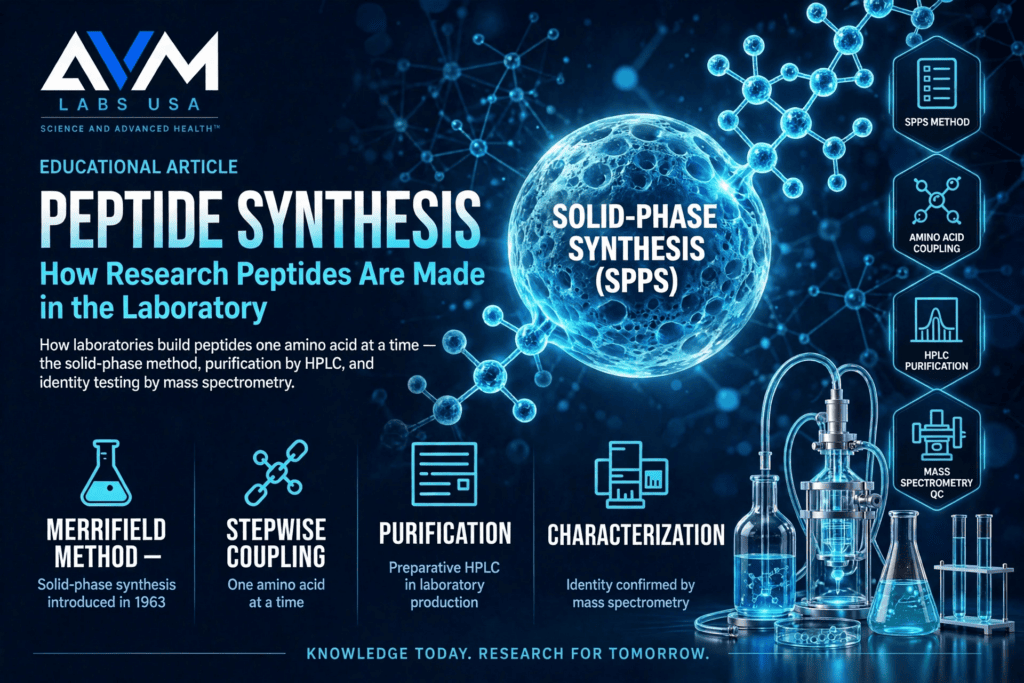
Peptide Synthesis: How Research Peptides Are Made in the Laboratory
Every research peptide in a laboratory freezer began as a string of individual amino acids and a chemistry problem: how to join them in exactly the right order, with nothing extra attached. The method that solved it — solid-phase peptide synthesis — is one of the quiet revolutions of modern chemistry, and it is still how research peptides are made today. This article explains how the process works, step by step, and why the steps after the synthesis matter just as much.
From amino acids to chains
A peptide is a chain of amino acids joined by peptide bonds, in a specific sequence (our guide on what peptides are covers the basics). Making one in the laboratory means forming those bonds one at a time, in order, while preventing every unwanted side reaction. In solution, that is slow and messy: each intermediate has to be isolated and purified before the next step. The breakthrough was to stop chasing the growing chain around a flask — and instead anchor it in place.
The Merrifield breakthrough
In 1963, Robert Bruce Merrifield published the idea that changed peptide chemistry: attach the first amino acid to an insoluble solid support — tiny resin beads — and build the chain there. Reagents are washed over the beads, excess is rinsed away, and the chain stays put through every step. Synthesis became a repeatable cycle instead of a series of purifications. Merrifield’s paper described the synthesis of a simple tetrapeptide; the method went on to earn the Nobel Prize in Chemistry in 1984 and remains the foundation of peptide manufacturing.
The solid-phase cycle, step by step
A modern solid-phase synthesis repeats the same cycle for every amino acid in the sequence:
- Anchor — the first amino acid is attached to the resin bead.
- Deprotect — the temporary protecting group on that amino acid is removed, exposing the site where the next bond will form.
- Couple — the next amino acid, itself protected, is added and forms a peptide bond with the chain.
- Wash — unreacted reagents and by-products are rinsed away; the chain stays on the bead.
- Repeat — deprotect, couple, wash, once per amino acid, until the full sequence is built.
- Cleave — the finished chain is cut from the resin and its remaining protecting groups are removed.
Two protecting-group strategies dominate the literature: the original Boc chemistry and the milder Fmoc chemistry that most laboratories use today. Automated synthesizers now run the cycle unattended, and microwave-assisted systems have shortened coupling times — but the logic of the cycle is Merrifield’s.
Cleavage is not the finish line: purification
What comes off the resin is a crude peptide: the correct sequence mixed with truncated chains, deletion sequences and side products from every imperfect step. This is why synthesis and purity are different subjects. Laboratories purify the crude material by preparative HPLC, collecting the fraction that matches the target and discarding the rest. How much of the final material is the intended peptide is exactly what a purity figure measures — our article on what peptide purity really means explains how to read those numbers.
Characterization: proving the chain is the right chain
A purified peak still has to be identified. Laboratories confirm the material with:
- Mass spectrometry — measures the molecular weight of the product and compares it with the theoretical weight of the intended sequence.
- Analytical HPLC — produces the chromatogram from which purity is calculated.
- Documentation — the results are recorded per batch in a Certificate of Analysis; our guide on how to read a peptide COA walks through each field.
Only after characterization is the material typically freeze-dried (lyophilized) into the stable powder form in which research peptides are supplied.
Why the method matters to researchers
Understanding synthesis explains the practical realities of research materials: why sequence errors are a known failure mode that only mass spectrometry can rule out, why purity is a percentage and never an assumption, and why two lots of the same peptide are documented separately. A laboratory that knows how its materials were made — and how they were verified — can attribute its results to the compound itself. That is the entire point of the documentation chain.
Research use notice
All AVM Labs USA materials are supplied strictly for in vitro laboratory and analytical research use only. They are not intended for human or veterinary use, and nothing in this article is a medical claim. This article summarizes published laboratory literature for educational purposes.
References in the literature
- Merrifield RB. Solid Phase Peptide Synthesis. I. The Synthesis of a Tetrapeptide. Journal of the American Chemical Society, 1963.
- Chan WC, White PD (eds.). Fmoc Solid Phase Peptide Synthesis: A Practical Approach. Oxford University Press, 2000.
- Jaradat DMM. Thirteen decades of peptide synthesis: key developments in solid phase peptide synthesis and amide bond formation utilized in peptide ligation. Amino Acids, 2018.